


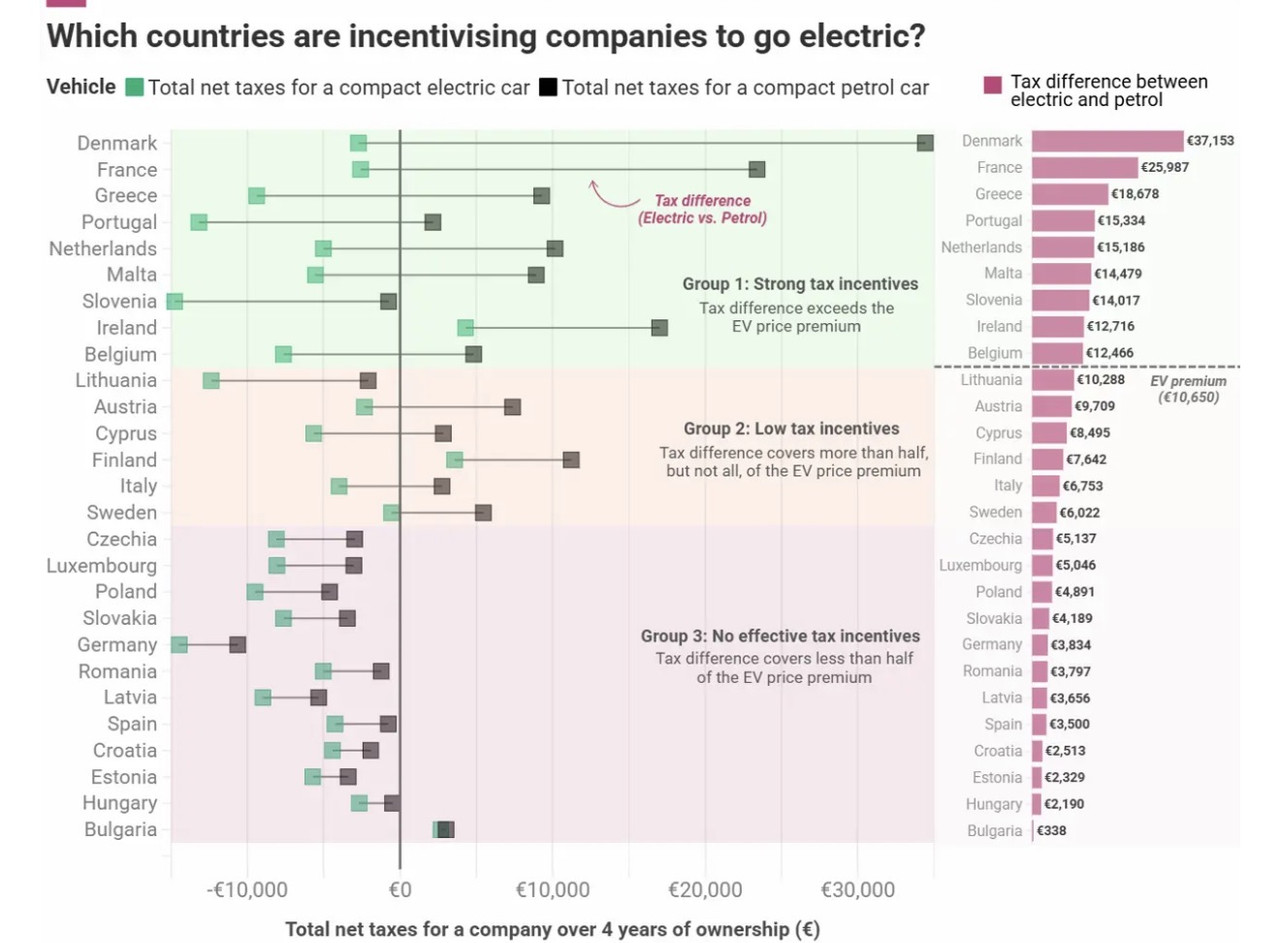
European countries that have aggressively increased taxes and registration penalties on Internal Combustion Engine (ICE) vehicles in favor of Electric Vehicles (EVs) include France, Denmark, the Netherlands, Belgium, and Norway.
These nations utilize steep CO₂ and weight-based taxes alongside company car reform to make ICE vehicles financially unviable compared to EVs
Implemented a stringent one-time tax/penalty system on bulky, CO₂-emitting cars, with combustion-engine models incurring up to €25,000 in taxes. This system heavily penalizes heavy polluting cars, and CO₂-based "benefit-in-kind" (BIK) company car taxes have increased dramatically for ICE models.
Leads Europe by making excise levies on ICE cars extremely high, reaching up to €37,000 on certain polluting vehicles. These eco-taxes strongly favor zero-emission vehicles, where EVs receive massive tax deductions.
Since January 2026, newly ordered ICE company cars have a 0% tax deductibility, whereas battery electric vehicles (BEVs) are 100% tax deductible. This forces corporate fleets to transition by heavily increasing the tax cost of ICEs.
Systematically raising road tax on ICE cars (planned to reach 100% of the standard rate by 2030) while providing favorable tax conditions to keep the total cost of ownership for compact EVs level with or cheaper than petrol cars.
Europe's pioneer EV market. While direct EV subsidies are being phased out in the deliberate transition, the government maintains strict purchase and emission taxes on remaining ICE vehicles to heavily preserve the relative advantage of BEVs.
Cars registered by companies represent about 60% of all new registrations in the EU and are therefore an important driver to accelerate electrification

 Reply With Quote
Bookmarks